Jesus Paid It All is a gospel hymn written in 1865 by Elvina M. Hall, a member of the Monument Street Methodist Church in Baltimore, and set to music by the church organist, John T. Grape. Its refrain sums up the gospel in four lines: Jesus paid it all, all to Him I owe; sin had left a crimson stain, He washed it white as snow. The picture comes straight from Isaiah 1:18, though your sins be as scarlet, they shall be as white as snow, and from the cross, where Jesus said It is finished (John 19:30).
Few hymns have such a simple beginning. One Sunday in 1865, Elvina Hall was sitting in the choir loft during a long prayer and, by her own account, her mind wandered to the thought of all that Christ had done for her. She wrote the words on the flyleaf of her hymnbook. Meanwhile the organist, John Grape, had composed a tune that his friends teased him about. When the pastor saw Hall's verses and Grape's melody, he noticed they fit, and the two were printed together. Today the hymn is sung in Baptist, Methodist and nondenominational churches, at baptisms, communion services and Good Friday, and a 2006 worship version with a new bridge brought it to a new generation. Below are the words as they were printed in 1894, followed by 12 KJV passages that stand behind each line.
Jesus Paid It All: the words
Verse 1
I hear the Saviour say,
Thy strength indeed is small;
Child of weakness, watch and pray,
Find in Me thine all in all.
Refrain:
Jesus paid it all,
All to Him I owe;
Sin had left a crimson stain;
He washed it white as snow.
Verse 2
Lord, now indeed I find
Thy power, and Thine alone,
Can change the leper's spots,
And melt the heart of stone.
Refrain:
Jesus paid it all,
All to Him I owe;
Sin had left a crimson stain;
He washed it white as snow.
Verse 3
For nothing good have I
Whereby Thy grace to claim;
I'll wash my garments white
In the blood of Calvary's Lamb.
Refrain:
Jesus paid it all,
All to Him I owe;
Sin had left a crimson stain;
He washed it white as snow.
Verse 4
When from my dying bed
My ransomed soul shall rise,
Then Jesus paid it all
Shall rend the vaulted skies.
Refrain:
Jesus paid it all,
All to Him I owe;
Sin had left a crimson stain;
He washed it white as snow.
Verse 5
And when before the throne
I stand in Him complete,
I'll lay my trophies down,
All down at Jesus' feet.
Refrain:
Jesus paid it all,
All to Him I owe;
Sin had left a crimson stain;
He washed it white as snow.
Words: Elvina M. Hall (1820-1889), written in 1865 at the Monument Street Methodist Church in Baltimore; music: John T. Grape (1865). Text copied from Gospel Hymns Nos. 1 to 6 Complete (New York and Chicago, 1894), hymn 588, checked against Hymns Consolation (Bliss), both Internet Archive scans; stanza 3 in the Bliss printing reads garment for garments. Many modern hymnals replace the last stanza's second half with Jesus died my soul to save, my lips shall still repeat; the 1894 lines are printed here. Modern versions with the added bridge Oh, praise the One who paid my debt (Passion, Kristian Stanfill and others, 2006) are copyrighted and are not reproduced. Public domain.
Jesus paid it all: the debt and the finished work
1. John 19:30
"When Jesus therefore had received the vinegar, he said, It is finished: and he bowed his head, and gave up the ghost."
The hymn's title is really a translation of one word Jesus spoke from the cross. When Jesus therefore had received the vinegar, he said, It is finished: and he bowed his head, and gave up the ghost. The Greek word, tetelestai, was used in everyday life for a task completed or a bill settled. Jesus did not say, I am finished, as a defeated man would. He announced that the work His Father gave Him was done. Nothing is left owing. Elvina Hall's refrain, Jesus paid it all, is a Sunday-school way of saying the same thing: the account between the sinner and God has been settled in full.
2. Colossians 2:14
"Blotting out the handwriting of ordinances that was against us, which was contrary to us, and took it out of the way, nailing it to his cross;"
Paul paints the same picture with a legal document. Christ was Blotting out the handwriting of ordinances that was against us, which was contrary to us, and took it out of the way, nailing it to his cross. The handwriting was a written record of debt, an IOU signed in our own hand. God did not ignore it or pretend it was not there. He nailed it to the cross, where Jesus paid it. That is why the hymn can say all to Him I owe. Our debt to God's law is cancelled, and what remains is a debt of love and gratitude to the One who paid it.
3. 1 Peter 1:18-19
"Forasmuch as ye know that ye were not redeemed with corruptible things, as silver and gold, from your vain conversation received by tradition from your fathers; But with the precious blood of Christ, as of a lamb without blemish and without spot:"
What did it cost? Peter answers: ye were not redeemed with corruptible things, as silver and gold but with the precious blood of Christ, as of a lamb without blemish and without spot. To redeem means to buy back, the word used for paying a slave's freedom. The payment was not money, which wears out and loses value, but the life of the sinless Lamb of God. The third stanza of the hymn picks up the same image: I'll wash my garments white in the blood of Calvary's Lamb. The cost was the highest one possible, and it was paid once for all.
4. Romans 6:23
"For the wages of sin is death; but the gift of God is eternal life through Jesus Christ our Lord."
For the wages of sin is death; but the gift of God is eternal life through Jesus Christ our Lord. Paul uses the language of payment here too. Sin pays a wage, and the wage is death. Every one of us has earned it. But eternal life is never called a wage. It is a gift, and a gift costs the receiver nothing because someone else has already paid for it. That is the whole logic of the refrain: Jesus paid it all, all to Him I owe. The wage we earned He took; the gift He earned He gives.
Sin had left a crimson stain: washed white as snow
5. Isaiah 1:18
"Come now, and let us reason together, saith the LORD: though your sins be as scarlet, they shall be as white as snow; though they be red like crimson, they shall be as wool."
Here is the hymn's central image, seven centuries before the cross. Come now, and let us reason together, saith the LORD: though your sins be as scarlet, they shall be as white as snow; though they be red like crimson, they shall be as wool. Scarlet and crimson dyes in the ancient world were colorfast; once a cloth was dyed, it could not be bleached. God compares our guilt to a stain that no human effort can wash out. Then He promises to do the impossible. Sin had left a crimson stain; He washed it white as snow. Elvina Hall simply set Isaiah's promise to rhyme.
6. Psalms 51:7
"Purge me with hyssop, and I shall be clean: wash me, and I shall be whiter than snow."
After his sin with Bathsheba, David prayed, Purge me with hyssop, and I shall be clean: wash me, and I shall be whiter than snow. Hyssop was the plant used to sprinkle blood at Passover and in the cleansing of lepers. David knew that only God could make him clean, and only through a sacrifice. This is the prayer that the hymn's refrain answers. What David asked for, Jesus provided. For more on David's prayer of repentance, see our page on Psalm 51.
7. 1 John 1:7
"But if we walk in the light, as he is in the light, we have fellowship one with another, and the blood of Jesus Christ his Son cleanseth us from all sin."
But if we walk in the light, as he is in the light, we have fellowship one with another, and the blood of Jesus Christ his Son cleanseth us from all sin. Notice the word all. Not some sin, not the small sins, not the sins committed before we believed, but all. And notice the tense: cleanseth, an ongoing washing for believers who keep walking with God and confessing their sins (1 John 1:9). The hymn's line For nothing good have I whereby Thy grace to claim is the honest starting point. The good news is that the blood of Christ does what our goodness never could.
8. Revelation 7:14
"And I said unto him, Sir, thou knowest. And he said to me, These are they which came out of great tribulation, and have washed their robes, and made them white in the blood of the Lamb."
John sees a great multitude in white robes before the throne and asks who they are. The answer: These are they which came out of great tribulation, and have washed their robes, and made them white in the blood of the Lamb. It is a paradox, robes made white by washing them in blood, and it is the same paradox Elvina Hall wrote into her third stanza. The last two stanzas of the hymn look ahead to this scene: the ransomed soul rising, the vaulted skies of heaven, and the believer standing before the throne complete in Christ.
Thy strength indeed is small: grace for the weak
9. 2 Corinthians 12:9
"And he said unto me, My grace is sufficient for thee: for my strength is made perfect in weakness. Most gladly therefore will I rather glory in my infirmities, that the power of Christ may rest upon me."
The hymn begins with Jesus speaking to a weak believer: Thy strength indeed is small; child of weakness, watch and pray, find in Me thine all in all. Paul heard almost the same words when he prayed three times for God to remove his thorn in the flesh. The answer was My grace is sufficient for thee: for my strength is made perfect in weakness. Paul did not get the healing he asked for. He got something better, the strength of Christ resting on him. The hymn invites the same exchange: our small strength for His sufficient grace.
10. Ezekiel 36:26
"A new heart also will I give you, and a new spirit will I put within you: and I will take away the stony heart out of your flesh, and I will give you an heart of flesh."
The second stanza says only God's power can change the leper's spots, and melt the heart of stone. That second phrase comes from God's promise through Ezekiel: A new heart also will I give you, and a new spirit will I put within you: and I will take away the stony heart out of your flesh, and I will give you an heart of flesh. Forgiveness is only half of salvation. God also changes the forgiven person from the inside. A heart of stone cannot love God; a heart of flesh can. Jesus paid for both: the pardon and the new heart.
11. Ephesians 2:8-9
"For by grace are ye saved through faith; and that not of yourselves: it is the gift of God: Not of works, lest any man should boast."
For by grace are ye saved through faith; and that not of yourselves: it is the gift of God: Not of works, lest any man should boast. The third stanza of the hymn is a confession of exactly this: For nothing good have I whereby Thy grace to claim. Grace cannot be claimed, earned or deserved, otherwise it would not be grace. That is what Jesus paid it all means. If Jesus paid it all, there is nothing left for us to add. We can only receive the gift with empty hands. For more verses on this, see our pages on grace and salvation.
12. Revelation 4:10-11
"The four and twenty elders fall down before him that sat on the throne, and worship him that liveth for ever and ever, and cast their crowns before the throne, saying, Thou art worthy, O Lord, to receive glory and honour and power: for thou hast created all things, and for thy pleasure they are and were created."
The hymn's last stanza, as printed in 1894, pictures the believer before the throne: I'll lay my trophies down, all down at Jesus' feet. That image comes from Revelation 4, where the twenty-four elders cast their crowns before the throne, saying, Thou art worthy, O Lord, to receive glory and honour and power. Whatever crowns or rewards God's people receive, they will hand them straight back to the One who paid for everything. The song ends where all worship ends: Christ alone is worthy, because Christ alone paid it all.
A short prayer
Lord Jesus, I come with nothing good of my own to offer You. My sins were as scarlet, and You washed them white as snow. Thank You for paying the whole debt on the cross and for saying, It is finished. When my strength is small, be my all in all. Melt every hard place in my heart and give me a heart that loves You. Since I am not my own, let my body and spirit glorify You today, and one day let me lay every crown at Your feet. Amen.
Go deeper: a SOAP study prompt
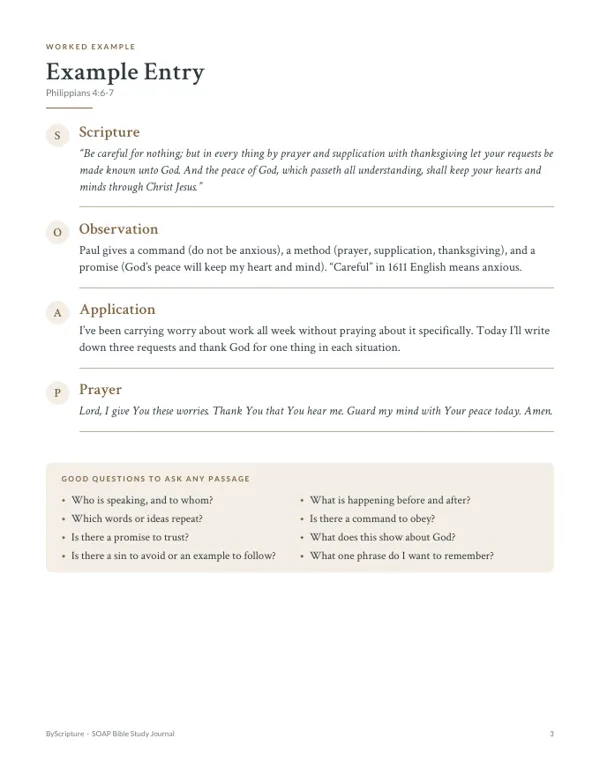
Pick one verse above and write: - Scripture: copy the verse by hand. - Observation: what does it say? Who is speaking, to whom? - Application: what does it mean for you today? - Prayer: turn it into a two-line prayer.
New to this method? See our Bible study guide or pick a Bible reading plan.
Get the free Lent Bible reading plan · Print the free Romans Road printable · Memorize Isaiah 1:18 with Scripture memory cards
Frequently asked questions
Who wrote Jesus Paid It All?
Elvina M. Hall (1820-1889) wrote the words in 1865 while sitting in the choir loft of the Monument Street Methodist Church in Baltimore, Maryland. The tune was written by the church's organist, John T. Grape, a coal merchant and amateur musician. Their pastor noticed that her verses fit his melody, and the hymn was published soon afterward.
What Bible verse is Jesus Paid It All based on?
The refrain draws mainly on Isaiah 1:18, where God promises that sins red like crimson shall be as white as snow, and on Jesus' cry It is finished in John 19:30. Other lines echo 2 Corinthians 12:9 (strength in weakness), Ezekiel 36:26 (the heart of stone), Revelation 7:14 (robes washed in the blood of the Lamb) and Revelation 4:10 (crowns laid before the throne).
Is Jesus Paid It All in the public domain?
Yes. The original words by Elvina Hall and the tune by John Grape were published in the 1860s, so they are in the public domain in the United States. The popular modern arrangement with the bridge Oh, praise the One who paid my debt (Alex Nifong, 2006) is a separate, copyrighted work and is not reproduced on this page.
Why is the last verse of Jesus Paid It All different in some hymnals?
Older printings, such as Gospel Hymns (1894), end with I'll lay my trophies down, all down at Jesus' feet. Many later hymnals print instead Jesus died my soul to save, my lips shall still repeat. Both versions point to the same scene of the believer before God's throne giving all the glory to Christ.
Sources: All Scripture quotations are from the King James Version (KJV), public domain in the United States. References were checked against the KJV text from bible-api.com.
Related: Rock of Ages · The Old Rugged Cross · When I Survey the Wondrous Cross · Lent Hymns · The Blood of Jesus · Grace · Good Friday · Redemption · Alas! and Did My Savior Bleed (lyrics)
Explore more: All Bible verses by topic · KJV Bible verses · Verse of the day · Prayers · Bible study · Bible reading plans