Romans 5:8 says, God commendeth his love toward us, in that, while we were yet sinners, Christ died for us. Commendeth means shows, proves or puts on display. Paul's point is that God's love did not wait for us to improve. Christ died for people who were still sinners, still without strength (Romans 5:6) and even still His enemies (Romans 5:10). That is what makes the cross the proof of God's love: it was given to people who had done nothing to deserve it. And because God loved us at our worst, Paul says, we can be sure He will save us to the end (Romans 5:9).
Romans 5:8 is one of the verses on the Romans Road, the short path through Paul's letter that many Christians use to explain the gospel, and it is a favorite reading in Lent and Holy Week. It sits in a paragraph that begins with peace. Paul has spent four chapters showing that everyone, Jew and Gentile, has sinned, and that God declares sinners righteous by faith in Christ. In chapter 5 he turns to what that means for the believer: peace with God, access into grace, hope that does not disappoint. Then he asks how we can be so sure, and his answer is the cross. He compares human love with God's love. A person might, just possibly, die for a very good man. God gave His Son for the ungodly. Below are 12 KJV passages in three groups: the verse in its own context, the love shown at the cross, and the confidence that follows from it.
While we were yet sinners: Romans 5:8 in its setting
1. Romans 5:8
"But God commendeth his love toward us, in that, while we were yet sinners, Christ died for us."
Look at the three parts of the verse. God commendeth his love toward us: the subject is God the Father, and the verb is present tense. He keeps on displaying His love every time the cross is preached. While we were yet sinners: the timing. Not after we repented, not once we started trying, but while we were still in our sins. Christ died for us: the act. For us means on our behalf, in our place. Many people believe God loves them only when they are doing well. Romans 5:8 says the opposite. The clearest proof of God's love was given to people at their worst.
2. Romans 5:6
"For when we were yet without strength, in due time Christ died for the ungodly."
Two verses earlier Paul describes the people Christ died for in even stronger words: when we were yet without strength, in due time Christ died for the ungodly. Without strength means helpless, unable to rescue ourselves. Ungodly means living without regard for God. The phrase in due time means at the right moment, the time God had appointed (Galatians 4:4). Christ did not die for good people who needed a little help. He died for the helpless and the godless. That is why no one is too far gone for the gospel. If you are without strength, you are exactly the kind of person Christ came for.
3. Romans 5:7
"For scarcely for a righteous man will one die: yet peradventure for a good man some would even dare to die."
Paul sets human love beside God's. For scarcely for a righteous man will one die: yet peradventure for a good man some would even dare to die. A righteous man is someone who is fair and upright; a good man is someone who is also warm and generous. You might, perhaps, find someone willing to die for a man like that. It would be rare and heroic. Then verse 8 begins with But. God did something no human being would think of doing: He gave His Son for people who were neither righteous nor good. The contrast shows that God's love is not a larger version of ours. It is a different kind.
4. Romans 5:10
"For if, when we were enemies, we were reconciled to God by the death of his Son, much more, being reconciled, we shall be saved by his life."
Paul goes further still: when we were enemies, we were reconciled to God by the death of his Son. Sinners are not just weak or lost. They are at war with God, whether they feel hostile or not (Romans 8:7). Yet God took the first step toward peace, and it cost Him His Son. Then Paul draws a conclusion: much more, being reconciled, we shall be saved by his life. If God loved us enough to reconcile us when we were enemies, He will certainly keep us now that we are His children. The risen Christ lives to finish the salvation His death began.
Christ died for us: the love shown at the cross
5. John 15:13
"Greater love hath no man than this, that a man lay down his life for his friends."
On the night before His death Jesus said, Greater love hath no man than this, that a man lay down his life for his friends. Within hours He did exactly that. But Romans 5:8 shows that His love went even beyond this standard. He laid down His life for us while we were sinners, before we were friends. In John 15 Jesus goes on to say, Ye are my friends, if ye do whatsoever I command you (John 15:14). The cross turns enemies into friends. It is greater love than the greatest human love, because it is given first and makes friendship possible.
6. 1 Peter 3:18
"For Christ also hath once suffered for sins, the just for the unjust, that he might bring us to God, being put to death in the flesh, but quickened by the Spirit:"
Peter explains what Christ's death for us accomplished: Christ also hath once suffered for sins, the just for the unjust, that he might bring us to God. Once means once for all; the sacrifice never needs repeating. The just for the unjust is the heart of the gospel, the innocent in place of the guilty. And the goal is personal: to bring us to God. Romans 5:8 says Christ died for us; Peter says He died to bring us home. Notice the last phrase too: put to death in the flesh, but quickened by the Spirit. The cross led to the empty tomb.
7. Isaiah 53:6
"All we like sheep have gone astray; we have turned every one to his own way; and the LORD hath laid on him the iniquity of us all."
Isaiah, writing seven centuries before the cross, describes the sinners Christ died for: All we like sheep have gone astray; we have turned every one to his own way. Sin is not only breaking rules. It is going our own way instead of God's. Then comes the remedy: the LORD hath laid on him the iniquity of us all. The verse begins with all and ends with all. Everyone has gone astray, and the sin of all who believe was laid on the Servant. This is what it means that Christ died for us while we were yet sinners. He carried what we had done. See our Isaiah 53 meaning.
8. Romans 8:32
"He that spared not his own Son, but delivered him up for us all, how shall he not with him also freely give us all things?"
Later in Romans Paul reasons from the cross to every other blessing: He that spared not his own Son, but delivered him up for us all, how shall he not with him also freely give us all things? The greatest gift has already been given. If God did not hold back His own Son, He will not hold back anything we truly need. This is the same logic as Romans 5:8-9. Believers sometimes wonder whether God really cares about their daily troubles. Paul's answer is to look at the cross. A God who gave that much will not be careless with the rest.
Much more then: the confidence God's love gives
9. Romans 5:9
"Much more then, being now justified by his blood, we shall be saved from wrath through him."
Paul's next sentence draws the first conclusion from verse 8: Much more then, being now justified by his blood, we shall be saved from wrath through him. The argument is from the harder to the easier. The hard thing was to die for sinners. The easier thing is to keep safe those who have already been made right with God. Justified means declared righteous, and it has happened now, not someday. Saved from wrath looks ahead to the day of judgment. A believer can face that day with confidence, not because of his own record, but because of the blood of Christ.
10. Romans 5:11
"And not only so, but we also joy in God through our Lord Jesus Christ, by whom we have now received the atonement."
The paragraph ends in joy: we also joy in God through our Lord Jesus Christ, by whom we have now received the atonement. Atonement in the KJV means reconciliation, being made one with God again (at-one-ment). Notice that Paul does not only rejoice in God's gifts. He rejoices in God Himself. The love shown in Romans 5:8 is not merely a fact to believe but a relationship to enjoy. The one who was an enemy is now glad in God. That is a good test of our understanding of the cross: does it make us love and enjoy the God who gave His Son for us?
11. Romans 8:38-39
"For I am persuaded, that neither death, nor life, nor angels, nor principalities, nor powers, nor things present, nor things to come, Nor height, nor depth, nor any other creature, shall be able to separate us from the love of God, which is in Christ Jesus our Lord."
Paul's great list ends in a promise that nothing shall be able to separate us from the love of God, which is in Christ Jesus our Lord. Death, life, angels, powers, things present, things to come, height, depth, any other creature: none of them can break it. Why can Paul be so certain? Because the love of God was not won by our goodness, so it cannot be lost by our weakness. It was settled at the cross while we were yet sinners. If God loved us before we loved Him, nothing that happens to us later can make Him stop.
12. 1 John 4:19
"We love him, because he first loved us."
John sums up the order of love in one line: We love him, because he first loved us. This is Romans 5:8 seen from the believer's side. God's love came first, while we were still sinners, and our love for Him is the response. That means a Christian's assurance never rests on how strongly he loves God, which rises and falls, but on how God loved him at the cross, which is fixed in history. It also means our love for others flows from the same source. People who know they were loved at their worst learn to love the unlovely. See our Bible verses about God's love.
A short prayer
Father, I thank You that You did not wait for me to become good before You loved me. While I was still a sinner, without strength and even Your enemy, Christ died for me. Thank You for the love You proved at the cross. Forgive me for the times I doubt that love or think I must earn it. Since You did not spare Your own Son, help me to trust You with everything else. Let nothing separate me from Your love in Christ Jesus, and teach me to rejoice in You. In Jesus' name, Amen.
Go deeper: a SOAP study prompt
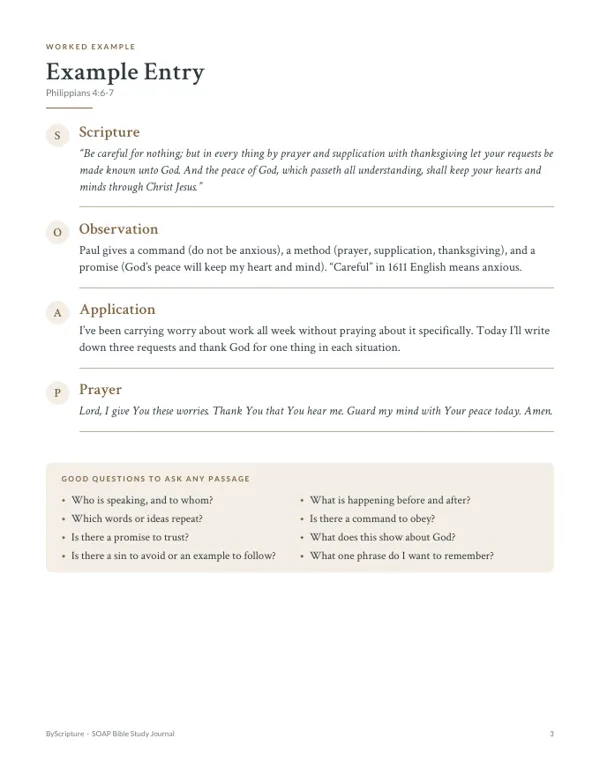
Pick one verse above and write: - Scripture: copy the verse by hand. - Observation: what does it say? Who is speaking, to whom? - Application: what does it mean for you today? - Prayer: turn it into a two-line prayer.
New to this method? See our Bible study guide or pick a Bible reading plan.
Print the free Romans Road printable · Get the free Lent Bible reading plan · Memorize Romans 5:8 with Scripture memory cards
Frequently asked questions
What does Romans 5:8 mean?
Romans 5:8 means that God proved His love for us by sending Christ to die for us while we were still sinners. His love did not depend on our becoming good first. Commendeth means shows or demonstrates. The verse is part of Paul's argument that believers can be confident of their salvation, because God loved them at their worst.
What does commendeth mean in Romans 5:8?
In the KJV commendeth means to show, prove or set forth clearly. Modern translations render it shows or demonstrates. Paul is saying that the cross is the evidence of God's love, the place where it was put on display for everyone to see.
Is Romans 5:8 part of the Romans Road?
Yes. The Romans Road usually includes Romans 3:23, Romans 6:23, Romans 5:8, Romans 10:9-10 and Romans 10:13. Romans 5:8 is the step that shows God's answer to our sin: Christ died for us. See our Romans Road page and free printable.
What is the context of Romans 5:8?
Romans 5:1-11 describes the blessings of being justified by faith: peace with God, access to grace, hope and joy. Verses 6-10 explain why that hope is sure. Christ died for the ungodly (v. 6), something rare even for a good man (v. 7), and if God reconciled us as enemies, He will surely save us now (vv. 9-10).
Sources: All Scripture quotations are from the King James Version (KJV), public domain in the United States. References were checked against the KJV text from bible-api.com.
Related: The Romans Road · John 3:16 Meaning · Isaiah 53 Meaning · Romans 8:28 Meaning · When I Survey the Wondrous Cross · God's Love · Love of Jesus · Salvation · Ephesians 2:8-9 meaning
Explore more: All Bible verses by topic · KJV Bible verses · Verse of the day · Prayers · Bible study · Bible reading plans