O Come, All Ye Faithful is the English version of the Latin Christmas hymn Adeste Fideles. Its earliest known copies were made by John Francis Wade, an English Catholic musician living in France, around 1751, and Frederick Oakeley translated it into English in 1841. The carol is one long invitation to worship, echoing the psalm "O come, let us worship and bow down: let us kneel before the LORD our maker" (Psalms 95:6) and the shepherds' words, "Let us now go even unto Bethlehem" (Luke 2:15). The words and tune are in the public domain.
Many Christmas carols tell the story. O Come, All Ye Faithful does something different: it invites. Every verse ends with the same call, O come, let us adore Him, repeated three times and rising each time, until the whole church sings Christ the Lord. Catholic and Protestant churches alike often open their Christmas services with it. Its second verse borrows the language of the Nicene Creed to say who the baby is: God of God, Light of Light, very God. Below are the four verses usually sung in English, the history of the Latin hymn, and 12 KJV verses behind its words. For another invitation to worship, see Joy to the World; for the angels' song, read Hark the Herald Angels Sing.
O Come, All Ye Faithful: the words
Verse 1
O come, all ye faithful, joyful and triumphant!
O come ye, O come ye to Bethlehem;
Come and behold Him
Born the King of Angels:
O come, let us adore Him,
O come, let us adore Him,
O come, let us adore Him,
Christ the Lord.
Verse 2
God of God, Light of Light,
Lo, He abhors not the Virgin's womb;
Very God, begotten, not created:
O come, let us adore Him,
O come, let us adore Him,
O come, let us adore Him,
Christ the Lord.
Verse 3
Sing, choirs of angels, sing in exultation,
Sing, all ye citizens of heaven above!
Glory to God, glory in the highest:
O come, let us adore Him,
O come, let us adore Him,
O come, let us adore Him,
Christ the Lord.
Verse 4
Yea, Lord, we greet Thee, born this happy morning;
Jesus, to Thee be glory given!
Word of the Father, now in flesh appearing!
O come, let us adore Him,
O come, let us adore Him,
O come, let us adore Him,
Christ the Lord.
Words: Latin hymn Adeste Fideles, earliest known in manuscripts and print by John Francis Wade (a manuscript dated 1751); English translation by Frederick Oakeley (1841, later revised). Tune: Adeste Fideles, also from Wade's books. Public domain. Many American hymnals print verse 2 as True God of true God, Light from Light Eternal, and some add translated stanzas about the shepherds and the Magi (William Thomas Brooke and others). Verse 4 is often kept for Christmas Day.
O come ye to Bethlehem (verse 1)
1. Psalms 95:6
"O come, let us worship and bow down: let us kneel before the LORD our maker."
The refrain of the carol, O come, let us adore Him, is the voice of the psalms. Psalm 95 was sung by Israel as a call to worship, and Christians have used it the same way for centuries: O come, let us worship and bow down: let us kneel before the LORD our maker. The psalm calls God our maker. The carol calls the baby in Bethlehem the same Lord, come in the flesh. Adore means to worship with love. The carol asks for more than admiration of a sweet nativity scene; it asks us to kneel. See Bible verses about worship.
2. Luke 2:15
"And it came to pass, as the angels were gone away from them into heaven, the shepherds said one to another, Let us now go even unto Bethlehem, and see this thing which is come to pass, which the Lord hath made known unto us."
O come ye, O come ye to Bethlehem. The carol puts us in the shepherds' sandals. After the angels went back into heaven, the shepherds did not debate what they had seen: the shepherds said one to another, Let us now go even unto Bethlehem, and see this thing which is come to pass, which the Lord hath made known unto us. They encouraged each other to go, and they went right away (Luke 2:16). O Come, All Ye Faithful is that same conversation set to music: believers calling one another to come and see. See the Christmas story in the Bible.
3. Psalms 24:7
"Lift up your heads, O ye gates; and be ye lift up, ye everlasting doors; and the King of glory shall come in."
Come and behold Him, born the King of Angels. Psalm 24 was sung as the ark of God was carried up to Jerusalem, and it ends with a shout to the city gates: Lift up your heads, O ye gates; and be ye lift up, ye everlasting doors; and the King of glory shall come in. Who is this King of glory? The psalm answers: the LORD of hosts, the Lord of heaven's armies (Psalms 24:10). At Bethlehem that King came in through the humblest door there was, a stable. The carol's first verse asks us to open the gates of our hearts and come out to meet Him. See Bible verses about Jesus as King.
4. Psalms 122:1
"I was glad when they said unto me, Let us go into the house of the LORD."
Joyful and triumphant: the carol pictures a crowd of pilgrims walking together, glad to be going. That was how Israel traveled to Jerusalem for the great feasts, singing the Psalms of Ascents on the road. One begins, I was glad when they said unto me, Let us go into the house of the LORD. At Christmas the journey is to Bethlehem rather than Jerusalem, and the house of the LORD is a stable. But the joy is the same. Going to worship with others is a gift, not a duty, and the carol is meant to be sung together.
God of God, Light of Light (verse 2)
5. John 1:1
"In the beginning was the Word, and the Word was with God, and the Word was God."
God of God, Light of Light: verse 2 comes from the Nicene Creed of 325 and 381, which confesses Jesus as God of God, Light of Light, very God of very God, begotten, not made. The creed was built on verses like this one: In the beginning was the Word, and the Word was with God, and the Word was God. Before Bethlehem, before creation, the Word already was. The baby the shepherds found is not a new being who began at Christmas. He is the eternal Son, who became flesh (John 1:14). That is why He can be adored.
6. John 8:12
"Then spake Jesus again unto them, saying, I am the light of the world: he that followeth me shall not walk in darkness, but shall have the light of life."
Light of Light. Jesus described Himself as the light of the world in the temple courts during the Feast of Tabernacles, when great lamps were lit: I am the light of the world: he that followeth me shall not walk in darkness, but shall have the light of life. The creed's phrase Light of Light means that the Son shares the very nature of the Father, as light from a flame is the same light. The child in the manger is the light that people have followed ever since. See Bible verses about light.
7. John 1:18
"No man hath seen God at any time; the only begotten Son, which is in the bosom of the Father, he hath declared him."
Very God, begotten, not created. The words only begotten appear several times in John's writings, and they mean unique, one of a kind. No man hath seen God at any time; the only begotten Son, which is in the bosom of the Father, he hath declared him. Created things have a beginning; the Son was begotten of the Father from eternity, not made. In the manger, the unseen God became someone shepherds could see. Lo, He abhors not the Virgin's womb: the eternal Son did not think it beneath Him to be born.
8. 1 John 5:20
"And we know that the Son of God is come, and hath given us an understanding, that we may know him that is true, and we are in him that is true, even in his Son Jesus Christ. This is the true God, and eternal life."
The second verse of the carol is a confession of faith: the baby is very God, true God. John closes his first letter with the same confession: And we know that the Son of God is come, and hath given us an understanding, that we may know him that is true, and we are in him that is true, even in his Son Jesus Christ. This is the true God, and eternal life. The Son of God is come is Christmas in six words. And He came so that we could know God, not just know about Him. See Bible verses about Jesus being God.
Sing, choirs of angels (verses 3-4)
9. Psalms 148:2
"Praise ye him, all his angels: praise ye him, all his hosts."
Sing, choirs of angels, sing in exultation. Psalm 148 calls everything in creation to praise God, starting at the top: Praise ye him, all his angels: praise ye him, all his hosts. The hosts are the armies of heaven. On the night Jesus was born, a multitude of the heavenly host did exactly what this psalm commands (Luke 2:13). The carol joins the psalm in calling the angels to sing, and then calls all ye citizens of heaven above to join them. If heaven sings at Christmas, the faithful on earth can hardly stay silent.
10. Psalms 103:20
"Bless the LORD, ye his angels, that excel in strength, that do his commandments, hearkening unto the voice of his word."
The angels in the carol are glad servants of God. David's psalm of thanks calls them to bless the LORD: Bless the LORD, ye his angels, that excel in strength, that do his commandments, hearkening unto the voice of his word. The angels at Bethlehem were strong and holy, and the shepherds were terrified of them (Luke 2:9). Yet they came with a message of joy, and they gave the glory to God, not to themselves. Glory to God, glory in the highest: the angels' song points away from the singers to the One they serve. See Bible verses about angels.
11. Psalms 118:24
"This is the day which the LORD hath made; we will rejoice and be glad in it."
Yea, Lord, we greet Thee, born this happy morning. Verse 4 is traditionally sung on Christmas Day itself, and it has the joy of this well-known psalm verse: This is the day which the LORD hath made; we will rejoice and be glad in it. Psalm 118 was sung at Passover, and it is quoted in the New Testament about Jesus as the stone the builders rejected (Psalms 118:22). Christmas morning is a day the LORD made in a special way: the day the promises came true. Jesus, to Thee be glory given! See Bible verses about joy.
12. Revelation 19:13
"And he was clothed with a vesture dipped in blood: and his name is called The Word of God."
Word of the Father, now in flesh appearing. Jesus is called the Word in John 1, and the same title appears at the end of the Bible. John sees the Lord coming in glory on a white horse: And he was clothed with a vesture dipped in blood: and his name is called The Word of God. The Word who appeared in flesh at Bethlehem is the Word who will return as King of kings. The carol's last verse holds both together: the One we greet as a baby on Christmas morning is the Lord of history, and He alone deserves the glory.
A short prayer
Lord Jesus Christ, I come to adore You. You are God of God and Light of Light, very God, and yet You were born for me. Thank You for not scorning the Virgin's womb or the stable, and for coming so that I could know the true God. With the shepherds, I say, Let us go to Bethlehem; with the wise men, I bow before the King; with the angels, I sing glory to God in the highest. Word of the Father, now in flesh appearing, to You be all glory given. Amen.
Go deeper: a SOAP study prompt
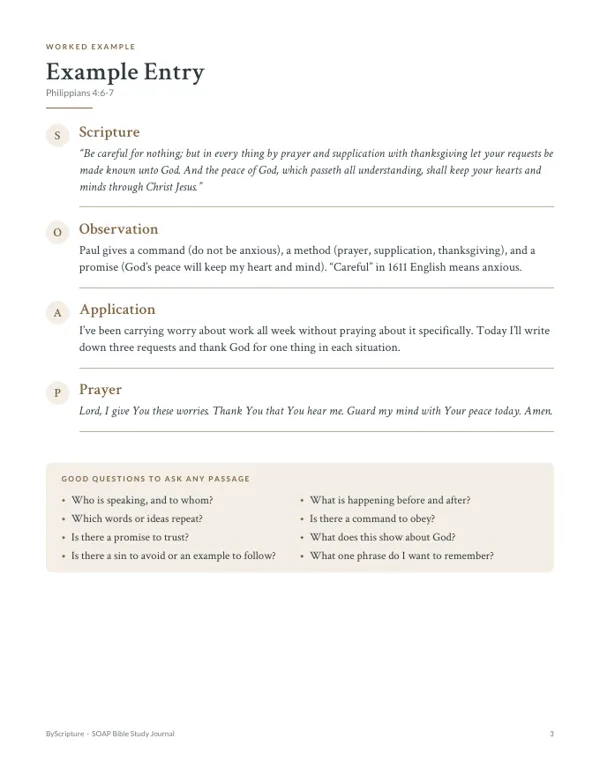
Pick one verse above and write: - Scripture: copy the verse by hand. - Observation: what does it say? Who is speaking, to whom? - Application: what does it mean for you today? - Prayer: turn it into a two-line prayer.
New to this method? See our Bible study guide or pick a Bible reading plan.
Print free Christmas Bible verse printables · Print free Christmas gift tags with Scripture · Keep worshiping after Christmas with the 30-Day Prayer Journal
Frequently asked questions
Who wrote O Come, All Ye Faithful?
The Latin original, Adeste Fideles, has been credited to several people, including John Francis Wade (1711-1786), an English Catholic who copied and sold music in France, and King John IV of Portugal. Wade's name is on the earliest printed copies, and a manuscript in his hand from 1751 survives, so most hymnals credit him. The best-known English translation is by Frederick Oakeley, 1841.
What does Adeste Fideles mean?
Adeste Fideles is Latin for Be present, faithful ones, or more loosely, Come, all ye faithful. The first verse continues Laeti triumphantes, joyful and triumphant, and Venite in Bethlehem, come to Bethlehem. The refrain Venite adoremus Dominum means Come, let us adore the Lord. Many churches still sing the Latin first verse alongside the English.
Is O Come, All Ye Faithful in the public domain?
Yes. The Latin words and tune date from the 1740s and 1750s, and Frederick Oakeley's English translation from 1841. Both are in the public domain. Newer translations of the extra verses, modern arrangements and recordings can be under copyright, but the traditional words and melody are free to sing, print and share.
What Bible verse is O Come, All Ye Faithful based on?
The carol follows Luke 2:15-16, where the shepherds say Let us now go even unto Bethlehem, and Matthew 2:1-11, where the wise men come to worship. The King of Angels recalls Psalm 24:7-10, the King of glory. The refrain echoes Psalm 95:6. Verse 2 uses the words of the Nicene Creed, based on John 1:1-18, and verse 3 echoes the angels' song in Luke 2:13-14.
Sources: All Scripture quotations are from the King James Version (KJV), public domain in the United States. References were checked against the KJV text from bible-api.com.
Related: Christmas · Hark the Herald Angels Sing · Angels We Have Heard on High · Joy to the World · The three wise men · The Christmas story in the Bible · Worship · Jesus is God
Explore more: All Bible verses by topic · KJV Bible verses · Verse of the day · Prayers · Bible study · Bible reading plans