Proverbs 3:5-6 says, "Trust in the LORD with all thine heart; and lean not unto thine own understanding." It continues, "In all thy ways acknowledge him, and he shall direct thy paths." It means trusting God completely rather than relying on your own judgment alone, bringing Him into every part of life, and believing that He will guide you. In context it is a father's advice to his son, and it comes with a warning in the next verse: "Be not wise in thine own eyes".
Proverbs 3:5-6 may be the most memorized passage in the Book of Proverbs. It hangs on kitchen walls, opens graduation speeches and is written inside Bibles given at baptisms. It is short enough to learn in a minute and deep enough to live on for a lifetime. But the two verses do not stand alone. They sit in the middle of a father's lesson to his son (Proverbs 3:1-12), and the verses around them explain what trust looks like in practice: keeping God's word, holding on to mercy and truth, turning away from evil and honoring God with your money. Below you will find Proverbs 3:1-8 in the King James Version, one verse at a time, with a short explanation of each, followed by four other verses that echo the same call to trust. For more verses on the theme, see Bible verses about trusting God and Bible verses about guidance.
Proverbs 3:1-4 (KJV): a father's lesson
1. Proverbs 3:1
"My son, forget not my law; but let thine heart keep my commandments:"
The chapter begins as a family conversation: My son, forget not my law. Proverbs 1 to 9 is written as a parent teaching a child, and law here means teaching or instruction, not a courtroom code. The father asks for more than memory: let thine heart keep my commandments. Real wisdom is not just knowing the right answer. It is loving it enough to hold on when life gets hard. Trust in verse 5 grows out of this kind of heart.
2. Proverbs 3:2
"For length of days, and long life, and peace, shall they add to thee."
For length of days, and long life, and peace, shall they add to thee. Proverbs often describes the usual way life goes, not an iron guarantee. Wise living tends to bring a steadier, longer, more peaceful life, while foolishness tends to cut life short. Faithful people still face sickness and loss, as Job and Jeremiah knew. But the word peace here is shalom, a wholeness that money cannot buy, and God gives it to those who walk with Him.
3. Proverbs 3:3
"Let not mercy and truth forsake thee: bind them about thy neck; write them upon the table of thine heart:"
Let not mercy and truth forsake thee. Mercy is steadfast, loyal love, and truth is faithfulness. Together they describe God's own character (Exodus 34:6). The father uses two pictures: bind them about thy neck, like a necklace everyone can see, and write them upon the table of thine heart, like words carved into a stone tablet. Mercy and truth should show on the outside and live on the inside. That is the kind of person who can trust God well.
4. Proverbs 3:4
"So shalt thou find favour and good understanding in the sight of God and man."
So shalt thou find favour and good understanding in the sight of God and man. The same was said of the boy Jesus, who grew in wisdom and stature, and in favour with God and man (Luke 2:52). A life of mercy and truth earns the respect of others and pleases God. Notice that God comes first. The goal is not popularity, but a life that is right before God and, as far as possible, honest and kind before people.
Proverbs 3:5-8 (KJV): trust in the LORD with all thine heart
5. Proverbs 3:5
"Trust in the LORD with all thine heart; and lean not unto thine own understanding."
Here is the heart of the passage: Trust in the LORD with all thine heart. In Hebrew thought the heart is the center of the whole person, mind, will and feelings together. All leaves no room for a backup plan. Then comes the warning: lean not unto thine own understanding. This does not mean we stop thinking. It means we do not rest our full weight on our own reasoning, the way you would lean on a cane. Our understanding is limited; God's is not (Isaiah 55:9).
6. Proverbs 3:6
"In all thy ways acknowledge him, and he shall direct thy paths."
In all thy ways acknowledge him. To acknowledge God is to know Him, recognize Him and include Him, not just to nod in His direction. All thy ways means work, money, family, friendships and decisions, big and small. The promise follows: and he shall direct thy paths. The Hebrew word suggests making a path straight or smooth. God does not always show the whole road at once, but He guides the one who keeps walking with Him, step by step.
7. Proverbs 3:7
"Be not wise in thine own eyes: fear the LORD, and depart from evil."
Verse 7 restates verse 5 as a command: Be not wise in thine own eyes. Being wise in your own eyes means being your own final authority, the opposite of trust. The cure is fear the LORD, and depart from evil. The fear of the LORD is reverent awe, the beginning of wisdom (Proverbs 1:7). Trusting God is not only a feeling of confidence. It shows up as turning away from what He calls evil. See Bible verses about the fear of the Lord.
8. Proverbs 3:8
"It shall be health to thy navel, and marrow to thy bones."
It shall be health to thy navel, and marrow to thy bones. The navel and the bones are pictures of the whole body, from the center to the core. Turning from evil and trusting God bring a kind of refreshment that reaches the whole person. Many people know how worry, guilt and pride wear down the body. Proverbs is not offering a medical formula, but it is saying something true: a heart at rest in God is good for you, body and soul.
The same call to trust elsewhere in Scripture
9. Proverbs 28:26
"He that trusteth in his own heart is a fool: but whoso walketh wisely, he shall be delivered."
Proverbs comes back to the theme near its end: He that trusteth in his own heart is a fool: but whoso walketh wisely, he shall be delivered. This is the negative side of Proverbs 3:5. Trusting your own heart, a popular modern slogan, is exactly what Proverbs warns against, because the heart can be mistaken or deceived (Jeremiah 17:9). Walking wisely means walking in God's ways, and that road leads to deliverance. David says something similar: Commit thy way unto the LORD (Psalm 37:5).
10. Jeremiah 17:7
"Blessed is the man that trusteth in the LORD, and whose hope the LORD is."
Blessed is the man that trusteth in the LORD, and whose hope the LORD is. Jeremiah contrasts two people. One trusts in man and is like a dry shrub in the desert (Jeremiah 17:5-6). The other trusts in God and is like a tree planted by the waters, with roots that reach the river, so that drought does not stop its fruit (Jeremiah 17:8). Trusting God does not remove the heat. It gives you roots deep enough to stay green in it.
11. Isaiah 26:3
"Thou wilt keep him in perfect peace, whose mind is stayed on thee: because he trusteth in thee."
Thou wilt keep him in perfect peace, whose mind is stayed on thee: because he trusteth in thee. In Hebrew, perfect peace is peace, peace, the word doubled for emphasis. A mind stayed on God is one that leans on Him, the same picture as Proverbs 3:5. When we lean on our own understanding, our thoughts race. When we lean on God, He keeps us. This is one of the best verses to pair with Proverbs 3:5-6 when you are anxious about a decision.
12. Psalms 32:8
"I will instruct thee and teach thee in the way which thou shalt go: I will guide thee with mine eye."
Here God Himself speaks: I will instruct thee and teach thee in the way which thou shalt go: I will guide thee with mine eye. This is the promise behind he shall direct thy paths. Guiding with the eye is the picture of someone who knows you so well that a look is enough. The next verse warns against being like a horse or mule that must be pulled with a bit (Psalm 32:9). God would rather lead a willing heart than drag a stubborn one.
A short prayer
Lord, I want to trust You with all my heart, not just the parts that feel safe. Forgive me for leaning on my own understanding and for trying to be wise in my own eyes. I acknowledge You in my work, my family, my money and my choices today. Direct my paths, even when I cannot see far ahead, and keep my mind stayed on You. Amen.
Go deeper: a SOAP study prompt
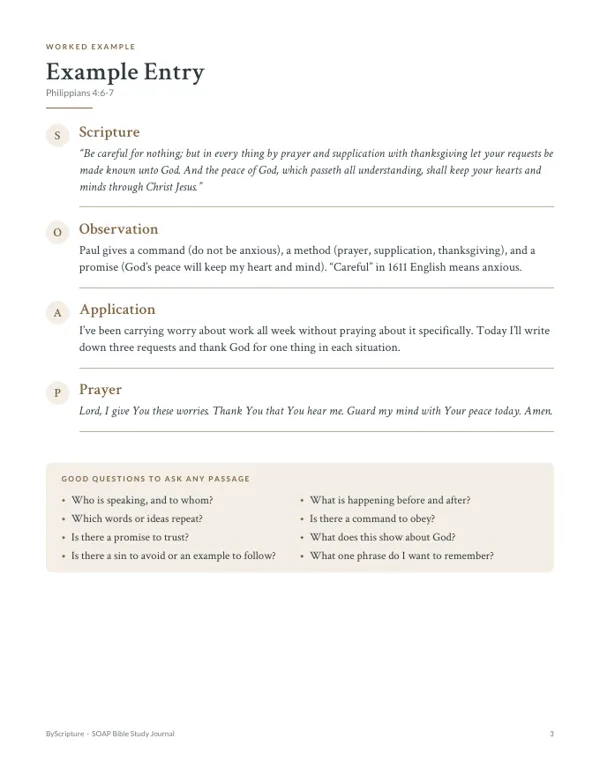
Pick one verse above and write: - Scripture: copy the verse by hand. - Observation: what does it say? Who is speaking, to whom? - Application: what does it mean for you today? - Prayer: turn it into a two-line prayer.
New to this method? See our Bible study guide or pick a Bible reading plan.
Memorize Proverbs 3:5-6 with Scripture memory cards · Download our free SOAP study page · Print free Bible verse bookmarks
Frequently asked questions
What does lean not unto thine own understanding mean?
It means not resting the full weight of your life on your own reasoning. Leaning is a picture of support, like leaning on a staff. God gave us minds and wants us to use them, but our understanding is limited, and it can be bent by fear, pride or desire. Proverbs 3:5 asks us to put our full weight on God and to hold our own conclusions with humility, checking them against His word.
Is Proverbs 3:5-6 a promise?
Proverbs is a book of wise sayings that describe how life usually works under God, so its verses are not always unconditional promises. But Proverbs 3:6 rests on God's own character: He does guide those who trust Him. It does not promise an easy road or a map of the future. It promises that when you acknowledge Him in all your ways, "he shall direct thy paths." The direction may come one step at a time.
Who wrote Proverbs 3?
The book opens with "The proverbs of Solomon the son of David, king of Israel" (Proverbs 1:1). Proverbs 1 to 9 is written as a father teaching his son, and many scholars think these chapters were collected and arranged over time, with Solomon as the main source. Later sections name other writers, including Agur (Proverbs 30) and King Lemuel (Proverbs 31).
How do I apply Proverbs 3:5-6 to a decision?
Start by praying honestly about the choice and telling God what you want. Read what Scripture says about the situation, ask wise believers for counsel (Proverbs 15:22) and pay attention to your motives. Then make the best decision you can, committing it to God, and keep walking. Trusting God is not waiting for a sign before every step; it is stepping forward with Him, ready to be corrected. See Bible verses about decisions.
Sources: All Scripture quotations are from the King James Version (KJV), public domain in the United States. References were checked against the KJV text from bible-api.com.
Related: Trusting God · Guidance · Decisions · Wisdom · Fear of the Lord · God's plan · Graduation · Jeremiah 29:11 meaning
Explore more: All Bible verses by topic · KJV Bible verses · Verse of the day · Prayers · Bible study · Bible reading plans