2 Chronicles 7:14 says, "If my people, which are called by my name, shall humble themselves, and pray, and seek my face, and turn from their wicked ways; then will I hear from heaven, and will forgive their sin, and will heal their land." God spoke these words to King Solomon after the dedication of the temple in Jerusalem. It is a promise that when God's people turn back to Him in humility, prayer and repentance, He hears, forgives and restores.
Few verses are prayed over a nation as often as 2 Chronicles 7:14. Churches read it on the National Day of Prayer, at revival meetings and in times of crisis. It is a verse about God's people, not about any government or party, and it begins with us: if my people. The setting is one of the high points of the Old Testament. King Solomon had finished the temple and prayed a long prayer of dedication (2 Chronicles 6), asking God to hear His people whenever they prayed toward that house. Fire fell from heaven and the glory of the LORD filled the temple. Then, some time later, God appeared to Solomon by night with His answer. 2 Chronicles 7:14 sits in the middle of that answer. Below are the key verses of the passage in the King James Version with their meaning, and four verses from elsewhere in Scripture that carry the same invitation to humble ourselves and pray. For more, see Bible verses about revival, Bible verses about repentance and Bible verses about prayer.
Solomon's prayer and the fire from heaven
1. 2 Chronicles 6:21
"Hearken therefore unto the supplications of thy servant, and of thy people Israel, which they shall make toward this place: hear thou from thy dwelling place, even from heaven; and when thou hearest, forgive."
This is the heart of Solomon's dedication prayer: Hearken therefore unto the supplications of thy servant, and of thy people Israel, which they shall make toward this place. He asks God to hear thou from thy dwelling place, even from heaven; and when thou hearest, forgive. Solomon knew a building could not contain God (2 Chronicles 6:18). He asked that God would listen when His people prayed. 2 Chronicles 7:14 is God's answer to this exact request, using the same words: hear, heaven, forgive.
2. 2 Chronicles 7:1
"Now when Solomon had made an end of praying, the fire came down from heaven, and consumed the burnt offering and the sacrifices; and the glory of the LORD filled the house."
Now when Solomon had made an end of praying, the fire came down from heaven, and consumed the burnt offering and the sacrifices; and the glory of the LORD filled the house. God answered at once, the way He had answered Moses at the tabernacle (Leviticus 9:24) and Elijah on Mount Carmel (1 Kings 18:38). The fire showed that God accepted the sacrifice and the house. His glory was so heavy that the priests could not go in (2 Chronicles 7:2).
3. 2 Chronicles 7:3
"And when all the children of Israel saw how the fire came down, and the glory of the LORD upon the house, they bowed themselves with their faces to the ground upon the pavement, and worshipped, and praised the LORD, saying, For he is good; for his mercy endureth for ever."
The people saw the fire and the glory, they bowed themselves with their faces to the ground upon the pavement, and worshipped, and praised the LORD, saying, For he is good; for his mercy endureth for ever. That refrain runs all through Chronicles and the Psalms (Psalm 136). Before God speaks of sin and judgment, the whole nation is on its face confessing that He is good. Humility before God starts with seeing how great and good He is.
4. 2 Chronicles 7:12
"And the LORD appeared to Solomon by night, and said unto him, I have heard thy prayer, and have chosen this place to myself for an house of sacrifice."
Later, the LORD appeared to Solomon by night, and said unto him, I have heard thy prayer, and have chosen this place to myself for an house of sacrifice. First Kings says this was after Solomon finished all his building projects (1 Kings 9:1-2). God's reply begins with reassurance: I have heard. Every promise that follows, including verse 14, rests on a God who listens to prayer.
2 Chronicles 7:13-16 (KJV): if my people
5. 2 Chronicles 7:13
"If I shut up heaven that there be no rain, or if I command the locusts to devour the land, or if I send pestilence among my people;"
God then describes hard times that could come: If I shut up heaven that there be no rain, or if I command the locusts to devour the land, or if I send pestilence among my people. In the covenant with Israel, drought, locusts and disease were among the warnings for persistent unfaithfulness (Deuteronomy 28). This verse sets the scene for verse 14. It is not a formula for explaining every disaster today, but a reminder that God sometimes uses hardship to call His people back.
6. 2 Chronicles 7:14
"If my people, which are called by my name, shall humble themselves, and pray, and seek my face, and turn from their wicked ways; then will I hear from heaven, and will forgive their sin, and will heal their land."
Now the promise: If my people, which are called by my name. It is addressed to God's own people, not to outsiders. Four actions follow. Humble themselves: stop pretending we are fine. And pray: bring it to God. And seek my face: want Him, not just His help. And turn from their wicked ways: real repentance. Then three answers: then will I hear from heaven, and will forgive their sin, and will heal their land. For Israel the land was the land of promise, and healing meant rain and harvest returning. Christians today pray it for their churches, their homes and their communities, starting with themselves.
7. 2 Chronicles 7:15
"Now mine eyes shall be open, and mine ears attent unto the prayer that is made in this place."
Now mine eyes shall be open, and mine ears attent unto the prayer that is made in this place. Attent means attentive. God promises to watch and listen. Solomon had asked that God's eyes would be open toward the temple day and night (2 Chronicles 6:20), and God says yes. For Christians, Jesus Himself is the meeting place between God and His people (John 2:19-21), so we pray with confidence that God is listening.
8. 2 Chronicles 7:16
"For now have I chosen and sanctified this house, that my name may be there for ever: and mine eyes and mine heart shall be there perpetually."
For now have I chosen and sanctified this house, that my name may be there for ever: and mine eyes and mine heart shall be there perpetually. God does not only promise to watch. He promises His heart. The next verses warn that if Israel turned away to other gods, even this house would become a ruin (2 Chronicles 7:19-22), and that later happened in 586 BC. God's promises call for faithfulness, but His heart toward His people is real.
Humble yourselves and pray: the same call elsewhere
9. Joel 2:13
"And rend your heart, and not your garments, and turn unto the LORD your God: for he is gracious and merciful, slow to anger, and of great kindness, and repenteth him of the evil."
And rend your heart, and not your garments, and turn unto the LORD your God. In the ancient world people tore their clothes in grief. Joel says God wants torn hearts, not just torn robes, real sorrow for sin rather than a show of it. The reason to return is God Himself: for he is gracious and merciful, slow to anger, and of great kindness. Joel was written in the aftermath of a locust plague, the very kind of hardship 2 Chronicles 7:13 describes.
10. Hosea 14:1
"O Israel, return unto the LORD thy God; for thou hast fallen by thine iniquity."
Hosea ends his book with an invitation: O Israel, return unto the LORD thy God; for thou hast fallen by thine iniquity. He then gives the people words to pray: Take away all iniquity, and receive us graciously (Hosea 14:2). This is 2 Chronicles 7:14 in another prophet's voice: turn back, pray and receive God's healing. God answers, I will heal their backsliding, I will love them freely (Hosea 14:4). The healing God promises begins in the heart.
11. James 4:10
"Humble yourselves in the sight of the Lord, and he shall lift you up."
Humble yourselves in the sight of the Lord, and he shall lift you up. James writes to Christians whose quarrels came from pride and selfish desire (James 4:1). His cure is the same as in Chronicles: humble yourselves, draw near to God, and He will draw near to you (James 4:8). Humility is the first step in 2 Chronicles 7:14, and James promises that God lifts up those who take it. See Bible verses about humility.
12. 1 Timothy 2:1-2
"I exhort therefore, that, first of all, supplications, prayers, intercessions, and giving of thanks, be made for all men; For kings, and for all that are in authority; that we may lead a quiet and peaceable life in all godliness and honesty."
Paul asks the church to pray for all men; For kings, and for all that are in authority; that we may lead a quiet and peaceable life in all godliness and honesty. He wrote this under Roman emperors who did not share his faith. Christians are called to pray for leaders of every party and none, not only the ones they voted for. This is a gentle and fitting companion to 2 Chronicles 7:14 on a day of prayer for a nation.
A short prayer
Lord, we are Your people, called by Your name. We humble ourselves before You. We confess our pride, our prayerlessness and the wicked ways we have excused. We seek Your face, not only Your help. Hear from heaven, forgive our sin, and heal what is broken in our hearts, our homes, our churches and our land. Begin with me. Amen.
Go deeper: a SOAP study prompt
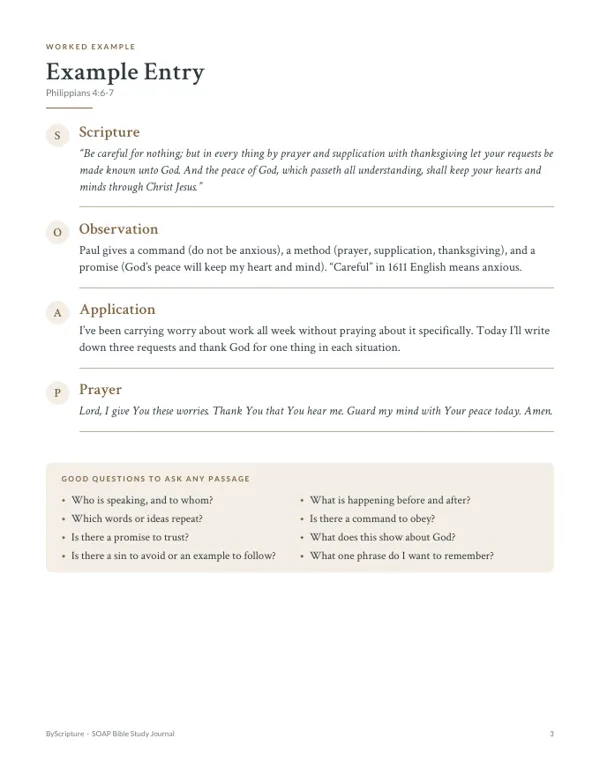
Pick one verse above and write: - Scripture: copy the verse by hand. - Observation: what does it say? Who is speaking, to whom? - Application: what does it mean for you today? - Prayer: turn it into a two-line prayer.
New to this method? See our Bible study guide or pick a Bible reading plan.
Pray daily with the 30-Day Prayer Journal · Download the free printable prayer journal · Download our free SOAP study page
Frequently asked questions
Who is 2 Chronicles 7:14 talking to?
God spoke 2 Chronicles 7:14 to King Solomon about the people of Israel, who were "called by my name". It was part of God's covenant with Israel concerning the temple and the land. Christians apply it today to the church, the people now called by Christ's name, as a call to humility, prayer and repentance. It is addressed to God's people first, not to a government or to unbelievers.
Does 2 Chronicles 7:14 apply to America?
The verse was not spoken to any modern nation, so it is not a direct promise to the United States or any other country. Many Christians pray it for their nation in a more general way: when God's people humble themselves, pray and turn from sin, God hears and forgives, and the effects can bless the communities they live in. The verse begins with the church's own repentance, not with blaming others.
What does heal their land mean?
For Israel, healing the land meant reversing the hardships described in 2 Chronicles 7:13: rain returning after drought, crops after locusts and health after plague. In the wider Bible, God's healing also includes restoring broken relationships, communities and hearts. Christians pray for this kind of healing for their towns and nations, while trusting God to answer in His way and time.
What is the context of 2 Chronicles 7:14?
King Solomon had finished building the temple and prayed a long prayer of dedication (2 Chronicles 6). Fire came down from heaven and God's glory filled the house. Later, God appeared to Solomon at night and answered his prayer (2 Chronicles 7:12-22). Verse 14 is part of that answer: a promise that when God's people turn back to Him, He will hear, forgive and heal. The following verses warn of what would happen if Israel turned away.
The National Day of Prayer in the United States is the first Thursday in May (May 6, 2027).
Sources: All Scripture quotations are from the King James Version (KJV), public domain in the United States. References were checked against the KJV text from bible-api.com.
Related: Revival · Repentance · Prayer · Humility · Power of prayer · Praying for others · Seeking the Lord · Forgiveness
Explore more: All Bible verses by topic · KJV Bible verses · Verse of the day · Prayers · Bible study · Bible reading plans