O Holy Night is a Christmas carol that began as a French poem, Minuit, chrétiens, written by Placide Cappeau in 1847 and set to music by Adolphe Adam the same year as Cantique de Noël. The English words almost everyone sings were written in 1855 by John Sullivan Dwight, an American minister and music critic. The carol celebrates the night of Christ's birth, the hope it brought to a weary world, and the call to worship Him as King. Its theme is the angel's news in Luke 2: "For unto you is born this day in the city of David a Saviour, which is Christ the Lord" (Luke 2:11). Dwight's words and Adam's tune are in the public domain.
It climbs to a high note on Fall on your knees that choirs and soloists prepare for all year, and it is often said to be the first piece of music ever broadcast by radio, on Christmas Eve 1906. It also has a remarkable history. A parish priest in the small French town of Roquemaure asked for a Christmas poem after the church's stained glass was restored; the poem became a song sung at Midnight Mass; and an American abolitionist, John Sullivan Dwight, turned it into English and gave the third verse its famous line about chains and the slave who is our brother. Below are Dwight's three verses, the story of the carol, and 12 KJV verses behind its words, verse by verse. For the whole Christmas story, read the Christmas story in the Bible; for another night carol, see Silent Night.
O Holy Night: the words
Verse 1
O holy night, the stars are brightly shining;
It is the night of the dear Saviour's birth.
Long lay the world in sin and error pining,
Till He appeared and the soul felt its worth.
A thrill of hope, the weary world rejoices,
For yonder breaks a new and glorious morn!
Fall on your knees! O hear the angel voices!
O night divine, O night when Christ was born!
O night divine! O night, O night divine!
Verse 2
Led by the light of faith serenely beaming,
With glowing hearts by His cradle we stand.
So led by light of a star sweetly gleaming,
Here came the wise men from the orient land.
The King of kings lay thus in lowly manger,
In all our trials born to be our friend.
He knows our need, to our weakness no stranger.
Behold your King, before Him lowly bend!
Behold your King, your King, before Him lowly bend!
Verse 3
Truly He taught us to love one another;
His law is love and His gospel is peace.
Chains shall He break, for the slave is our brother;
And in His name all oppression shall cease.
Sweet hymns of joy in grateful chorus raise we;
Let all within us praise His holy name.
Christ is the Lord! Then ever, ever praise we!
His power and glory evermore proclaim!
His power and glory evermore proclaim!
Words: English by John Sullivan Dwight (1855), from the French poem Minuit, chrétiens by Placide Cappeau (1847). Music: Cantique de Noël by Adolphe Adam (1847). Public domain. Many singers repeat Fall on your knees after the first verse, and some hymnals print the last lines of verse 1 as O night divine, O night when Christ was born, without the extra line. Dwight's English is a free version, not a word-for-word translation of the French. Text checked against the Wikipedia transcription and the 1875 printing in Gems of English Song (Boston: Oliver Ditson), which ends verse 1 with O night, O holy night, O night divine, has Here come the wise men, and ends verse 2 with before Him bend.
Long lay the world in sin and error pining (verse 1)
1. 1 John 3:5
"And ye know that he was manifested to take away our sins; and in him is no sin."
Long lay the world in sin and error pining, till He appeared. Pining means wasting away with longing. The world had waited centuries for a Savior, and John explains why He came: And ye know that he was manifested to take away our sins; and in him is no sin. Manifested means made visible, the same idea as appeared in the carol. Jesus did not come only to teach or to inspire. He came to take sin away, and He could do it because He had none of His own. That is why the night of His birth is called holy: the sinless One had entered a sinful world to save it.
2. Romans 15:13
"Now the God of hope fill you with all joy and peace in believing, that ye may abound in hope, through the power of the Holy Ghost."
A thrill of hope, the weary world rejoices. Hope in the Bible is not wishful thinking. It is confidence in what God has promised. Paul prays: Now the God of hope fill you with all joy and peace in believing, that ye may abound in hope, through the power of the Holy Ghost. Many people come to Christmas tired and worn down. The carol does not deny that the world is weary. It says that in Christ, even a weary world has reason to rejoice. See Bible verses about hope.
3. 2 Peter 1:19
"We have also a more sure word of prophecy; whereunto ye do well that ye take heed, as unto a light that shineth in a dark place, until the day dawn, and the day star arise in your hearts:"
For yonder breaks a new and glorious morn. Dwight pictures Christ's birth as dawn breaking after a long night. Peter uses the same picture for the promises of God: We have also a more sure word of prophecy; whereunto ye do well that ye take heed, as unto a light that shineth in a dark place, until the day dawn, and the day star arise in your hearts. The prophets were a lamp in the dark; Jesus is the sunrise they pointed to. The day star is the morning star that announces the day. The same light that broke over Bethlehem is meant to rise in each heart that trusts Him. See Bible verses about light.
4. Psalms 95:6
"O come, let us worship and bow down: let us kneel before the LORD our maker."
Fall on your knees! is the most famous line of the carol, and it is a call to worship, not just a high note. The psalmist calls God's people the same way: O come, let us worship and bow down: let us kneel before the LORD our maker. The carol invites every listener to do the same, wherever they are on Christmas Eve. See Bible verses about worship.
The King of kings lay thus in lowly manger (verse 2)
5. Isaiah 60:3
"And the Gentiles shall come to thy light, and kings to the brightness of thy rising."
Here came the wise men from the orient land. Orient means the East. Centuries before Jesus was born, Isaiah saw nations and rulers drawn to the light of God: And the Gentiles shall come to thy light, and kings to the brightness of thy rising. The wise men from the East were the first of those Gentiles, led by a star to the brightness of the newborn King. The church remembers their visit at Epiphany on January 6. See the three wise men and We Three Kings.
6. Philippians 2:7
"But made himself of no reputation, and took upon him the form of a servant, and was made in the likeness of men:"
The King of kings lay thus in lowly manger. The wonder of Christmas is that the highest came down to the lowest place. Paul says the Son of God made himself of no reputation, and took upon him the form of a servant, and was made in the likeness of men. He did not stop being God, but He set aside His glory and took a real human life, beginning in a borrowed feeding trough. He came low enough to reach anyone. See Bible verses about humility.
7. Hebrews 4:15
"For we have not an high priest which cannot be touched with the feeling of our infirmities; but was in all points tempted like as we are, yet without sin."
In all our trials born to be our friend. He knows our need, to our weakness no stranger. This may be the most comforting line in the carol, and it is straight from Hebrews: For we have not an high priest which cannot be touched with the feeling of our infirmities; but was in all points tempted like as we are, yet without sin. Infirmities means weaknesses. Jesus was hungry, tired, grieved and tempted. He knows what it is to be human from the inside. When you pray this Christmas, you are speaking to Someone who understands, and who never sinned, so He can help. See Bible verses about strength in weakness.
8. Revelation 19:16
"And he hath on his vesture and on his thigh a name written, KING OF KINGS, AND LORD OF LORDS."
Behold your King, before Him lowly bend! The baby in the manger is also the King of all kings. In John's vision, Jesus returns in glory: And he hath on his vesture and on his thigh a name written, KING OF KINGS, AND LORD OF LORDS. The carol joins the two ends of the story. He came once in weakness, laid in a manger; He will come again in power, crowned with many crowns. See Crown Him with Many Crowns.
Truly He taught us to love one another (verse 3)
9. John 13:34
"A new commandment I give unto you, That ye love one another; as I have loved you, that ye also love one another."
Truly He taught us to love one another. Dwight's third verse turns from the manger to the life and teaching of Jesus. On the night before He died, Jesus said: A new commandment I give unto you, That ye love one another; as I have loved you, that ye also love one another. The commandment was new because of its measure: as I have loved you. His law is love and His gospel is peace sums up what the child of Bethlehem grew up to teach. See Bible verses about love.
10. Luke 4:18
"The Spirit of the Lord is upon me, because he hath anointed me to preach the gospel to the poor; he hath sent me to heal the brokenhearted, to preach deliverance to the captives, and recovering of sight to the blind, to set at liberty them that are bruised,"
Chains shall He break. When Jesus began His ministry in Nazareth, He read from Isaiah and said the words were fulfilled in Him: The Spirit of the Lord is upon me, because he hath anointed me to preach the gospel to the poor; he hath sent me to heal the brokenhearted, to preach deliverance to the captives, and recovering of sight to the blind, to set at liberty them that are bruised. Deliverance to the captives is good news for anyone in chains, whether the chains are sin, fear or injustice. Dwight, a Boston abolitionist, wrote his English in 1855, six years before the Civil War, and he heard this promise in the carol.
11. Galatians 3:28
"There is neither Jew nor Greek, there is neither bond nor free, there is neither male nor female: for ye are all one in Christ Jesus."
For the slave is our brother. In Paul's day, slaves and free people sat side by side in the same churches, and Paul wrote: There is neither Jew nor Greek, there is neither bond nor free, there is neither male nor female: for ye are all one in Christ Jesus. Bond means enslaved. Paul is not saying differences disappear, but that in Christ no one is worth less than anyone else. The gospel built a family where a slave and a master could call each other brother (Philemon 1:16). Dwight's line made that truth part of how America sang at Christmas. See Bible verses about unity.
12. John 8:36
"If the Son therefore shall make you free, ye shall be free indeed."
And in His name all oppression shall cease. Jesus promised a freedom deeper than any law can give: If the Son therefore shall make you free, ye shall be free indeed. He was speaking to people who thought they were free but were slaves to sin (John 8:34). The freedom He gives starts in the heart and will one day be complete, when every wrong is put right. The carol ends in praise because the One who was born that night is the Lord who sets people free. See Bible verses about freedom.
A short prayer
Lord Jesus, on this holy night I kneel before You. The world lay long in sin and error, and You appeared to take away our sins. Thank You for the thrill of hope You bring to a weary world, and for the new and glorious morning of Your grace. You are the King of kings, yet You lay in a lowly manger, and You know my weakness from the inside. Teach me to love others as You have loved me. Break every chain that holds me, and use me to bring Your freedom and peace to others. I praise Your holy name. Amen.
Go deeper: a SOAP study prompt
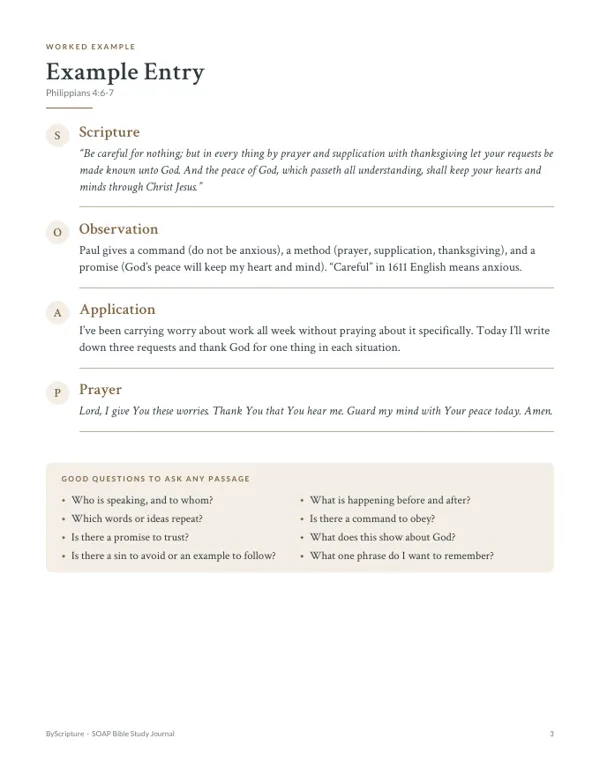
Pick one verse above and write: - Scripture: copy the verse by hand. - Observation: what does it say? Who is speaking, to whom? - Application: what does it mean for you today? - Prayer: turn it into a two-line prayer.
New to this method? See our Bible study guide or pick a Bible reading plan.
Light the Advent candles with the free Advent candle printable · Print free Christian Christmas coloring pages · Memorize Luke 2:11 with Scripture memory cards
Frequently asked questions
Who wrote O Holy Night?
The French words, Minuit, chrétiens, were written by Placide Cappeau, a wine merchant and poet from Roquemaure in southern France, in December 1847. The parish priest had asked him for a Christmas poem. Adolphe Adam, a well-known composer of opera and ballet, set it to music within days, and it was sung at Midnight Mass that Christmas. The English words were written in 1855 by John Sullivan Dwight, a Boston minister and music critic who published his own music journal.
Is O Holy Night in the public domain?
Yes. Cappeau's French words and Adam's music date from 1847, and Dwight's English words from 1855, so all of them are in the public domain in the United States. The words printed on this page are Dwight's text as it appears in 19th-century sheet music, such as G. Schirmer's Social Evenings (1871) and Oliver Ditson's Gems of English Song (1875). Modern recordings, arrangements and new verses by recent writers can still be under copyright, so check before you copy someone else's arrangement or reprint a newer version.
What does fall on your knees mean in O Holy Night?
It is a call to worship. In the Bible, falling on your knees or bowing down is how people honored God and kings (Psalm 95:6). The wise men fell down and worshipped the child Jesus (Matthew 2:11). The carol asks the listener to do the same: to hear the angels' news and respond by bowing before Christ. It does not mean anyone must kneel to sing it; it is about the heart's posture of humble worship before the newborn King.
What Bible passage is O Holy Night based on?
The first verse draws on Luke 2:8-14, the angels announcing the Savior's birth to shepherds by night. The second verse follows the wise men in Matthew 2:1-11 and echoes Hebrews 4:15 on Christ knowing our weakness. The third verse sums up Jesus' teaching and ministry: the new commandment to love one another (John 13:34), good news for captives (Luke 4:18) and freedom in the Son (John 8:36). This page lists 12 KJV verses behind the carol.
Sources: All Scripture quotations are from the King James Version (KJV), public domain in the United States. References were checked against the KJV text from bible-api.com.
Related: Christmas · The Christmas story in the Bible · Silent Night · The First Noel · Hark the Herald Angels Sing · Three wise men · Hope · Christmas prayer
Explore more: All Bible verses by topic · KJV Bible verses · Verse of the day · Prayers · Bible study · Bible reading plans