1 Corinthians 15 is the Bible's longest teaching on the resurrection. Paul begins with the gospel itself, "how that Christ died for our sins according to the scriptures; And that he was buried, and that he rose again the third day" (1 Corinthians 15:3-4), and lists the people who saw the risen Jesus. He then argues that if Christ is not raised, faith is vain, but "now is Christ risen from the dead, and become the firstfruits of them that slept" (1 Corinthians 15:20). The chapter ends with the promise that the dead will be raised incorruptible and the taunt, "O death, where is thy sting?" (1 Corinthians 15:55).
Some of the Christians in Corinth had begun to say that there is no resurrection of the dead (1 Corinthians 15:12). They still believed in Jesus, but they could not accept that dead bodies would be raised. Perhaps they thought, like many Greeks, that the body was a prison the soul escapes at death. Paul's answer is 58 verses long and is often called the Resurrection Chapter. It is read at Easter, at funerals and whenever Christians need to remember why the empty tomb matters. Paul builds his case in steps. First he restates the gospel and the eyewitnesses. Then he shows what would be lost if Christ were not raised. Then he explains that Christ's resurrection is the first of a great harvest, and he describes the new bodies God will give His people. He ends in a shout of victory. This page gives twelve readings from the chapter in the King James Version, with a short note on each. For more verses on the theme, see Bible verses about the resurrection of Jesus and Bible verses about Easter.
The gospel and the witnesses (1 Corinthians 15:1-11)
1. 1 Corinthians 15:1-2
"Moreover, brethren, I declare unto you the gospel which I preached unto you, which also ye have received, and wherein ye stand; By which also ye are saved, if ye keep in memory what I preached unto you, unless ye have believed in vain."
Paul begins by reminding the Corinthians of what they already know: I declare unto you the gospel which I preached unto you, which also ye have received, and wherein ye stand. The gospel is something they received, something they stand on now, and the means by which they are saved. He adds a warning: if ye keep in memory what I preached unto you, unless ye have believed in vain. If they drop the resurrection, they drop the gospel itself. Everything in the chapter depends on getting this first point right.
2. 1 Corinthians 15:3-4
"For I delivered unto you first of all that which I also received, how that Christ died for our sins according to the scriptures; And that he was buried, and that he rose again the third day according to the scriptures:"
These two verses are among the oldest summaries of Christian faith, written about twenty-five years after Jesus died. Paul says he delivered what he had received, words used for passing on a careful tradition. Christ died for our sins according to the scriptures; And that he was buried, and that he rose again the third day according to the scriptures. Four facts: He died, for our sins, He was buried, He rose. Burial shows He was truly dead. According to the scriptures shows it fulfilled God's plan in passages like Isaiah 53. See Isaiah 53 meaning.
3. 1 Corinthians 15:5-6
"And that he was seen of Cephas, then of the twelve: After that, he was seen of above five hundred brethren at once; of whom the greater part remain unto this present, but some are fallen asleep."
Paul then lists eyewitnesses. Jesus was seen of Cephas, which is Peter, then of the twelve. Then a remarkable claim: he was seen of above five hundred brethren at once; of whom the greater part remain unto this present. In other words, most of them were still alive and could be asked. Paul was writing a public letter that skeptics could check. The resurrection was not presented as a private vision or a spiritual idea but as an event in history, seen by many people at the same time.
4. 1 Corinthians 15:7-8
"After that, he was seen of James; then of all the apostles. And last of all he was seen of me also, as of one born out of due time."
After that, he was seen of James; then of all the apostles. This James was the Lord's brother, who had not believed in Jesus during His ministry (John 7:5) but became a leader of the church in Jerusalem. Something changed him. And last of all he was seen of me also, as of one born out of due time. Paul had been the church's fiercest enemy until the risen Jesus met him on the road to Damascus (Acts 9:3-6). The resurrection turned a skeptical brother and a persecutor into witnesses who were willing to die for it.
If Christ be not raised (1 Corinthians 15:12-28)
5. 1 Corinthians 15:14
"And if Christ be not risen, then is our preaching vain, and your faith is also vain."
Now Paul asks what would follow if there were no resurrection. And if Christ be not risen, then is our preaching vain, and your faith is also vain. Vain means empty. Paul does not say that Christianity would still be a nice moral system without the resurrection. He says it would be worthless. He even adds that the apostles would be false witnesses, lying about God (1 Corinthians 15:15). Christian faith stands or falls on a historical event. That is a bold claim, and Paul makes it on purpose.
6. 1 Corinthians 15:17
"And if Christ be not raised, your faith is vain; ye are yet in your sins."
And if Christ be not raised, your faith is vain; ye are yet in your sins. Here is the most personal consequence. The cross deals with sin, but the resurrection is God's proof that the payment was accepted. Paul writes elsewhere that Jesus was raised again for our justification (Romans 4:25). Without the resurrection, we would have a dead martyr, not a living Savior, and no assurance that our sins are forgiven. Paul adds that if our hope in Christ is for this life only, we are of all men most miserable (1 Corinthians 15:19).
7. 1 Corinthians 15:20
"But now is Christ risen from the dead, and become the firstfruits of them that slept."
Then the chapter turns: But now is Christ risen from the dead, and become the firstfruits of them that slept. Firstfruits were the first sheaf of the harvest, offered to God as a pledge that the rest of the harvest was coming (Leviticus 23:10-11). Jesus rose on the day after the Sabbath of Passover week, the very day the firstfruits were offered. His resurrection is not a one-time miracle but the first of many. Those who have slept, Paul's gentle word for believers who have died, will follow.
8. 1 Corinthians 15:22
"For as in Adam all die, even so in Christ shall all be made alive."
For as in Adam all die, even so in Christ shall all be made alive. Paul sees two heads of humanity. Through Adam, the first man, sin and death entered the world, and everyone shares his fate. Through Christ, the second Adam, life comes to all who belong to Him. Paul adds that the order is Christ first, then afterward they that are Christ's at his coming (1 Corinthians 15:23). The last enemy to be destroyed is death itself (1 Corinthians 15:26). See Bible verses about eternal life.
Death is swallowed up in victory (1 Corinthians 15:35-58)
9. 1 Corinthians 15:51-52
"Behold, I shew you a mystery; We shall not all sleep, but we shall all be changed, In a moment, in the twinkling of an eye, at the last trump: for the trumpet shall sound, and the dead shall be raised incorruptible, and we shall be changed."
After explaining that our new bodies will be like a plant compared to its seed, imperishable, glorious and powerful (1 Corinthians 15:42-44), Paul reveals a mystery: We shall not all sleep, but we shall all be changed, In a moment, in the twinkling of an eye, at the last trump. Believers alive when Christ returns will not die but will be transformed. The dead shall be raised incorruptible, and we shall be changed. Many Christians link this passage with 1 Thessalonians 4:16-17. Handel set these words in the Messiah: The trumpet shall sound.
10. 1 Corinthians 15:54-55
"So when this corruptible shall have put on incorruption, and this mortal shall have put on immortality, then shall be brought to pass the saying that is written, Death is swallowed up in victory. O death, where is thy sting? O grave, where is thy victory?"
When that change comes, then shall be brought to pass the saying that is written, Death is swallowed up in victory. Paul is quoting Isaiah 25:8, a prophecy of the great feast at the end of time. Then he quotes Hosea 13:14 and turns it into a taunt: O death, where is thy sting? O grave, where is thy victory? Death is pictured as a scorpion or bee whose sting has been pulled out. It can still frighten, but it can no longer kill forever. Christians often read these verses at funerals. See Bible verses about death.
11. 1 Corinthians 15:57
"But thanks be to God, which giveth us the victory through our Lord Jesus Christ."
Paul explains where death's sting came from: The sting of death is sin; and the strength of sin is the law (1 Corinthians 15:56). Sin gives death its power, and the law exposes sin. But Christ has dealt with both. So the chapter bursts into thanks: But thanks be to God, which giveth us the victory through our Lord Jesus Christ. The victory is a gift, giveth, not something we win. It is present tense: God gives it now. Easter is not only a memory; it is a victory we live in.
12. 1 Corinthians 15:58
"Therefore, my beloved brethren, be ye stedfast, unmoveable, always abounding in the work of the Lord, forasmuch as ye know that your labour is not in vain in the Lord."
After all that theology, Paul ends with very practical advice: Therefore, my beloved brethren, be ye stedfast, unmoveable, always abounding in the work of the Lord. Because the resurrection is true, what we do for God matters forever. Forasmuch as ye know that your labour is not in vain in the Lord. Compare verse 14: if Christ were not raised, our faith would be vain. Because He is raised, our labour is not in vain. The hope of Easter is meant to make us faithful in ordinary work on Monday. See Bible verses about never giving up.
A short prayer
Lord Jesus, thank You that You died for our sins according to the scriptures, that You were buried, and that You rose again the third day. Because You are risen, my faith is not vain and I am not still in my sins. Thank You that You are the firstfruits and that one day the dead will be raised incorruptible. O death, where is your sting? Make me stedfast and unmoveable, always abounding in Your work, knowing my labour is not in vain in You. Amen.
Go deeper: a SOAP study prompt
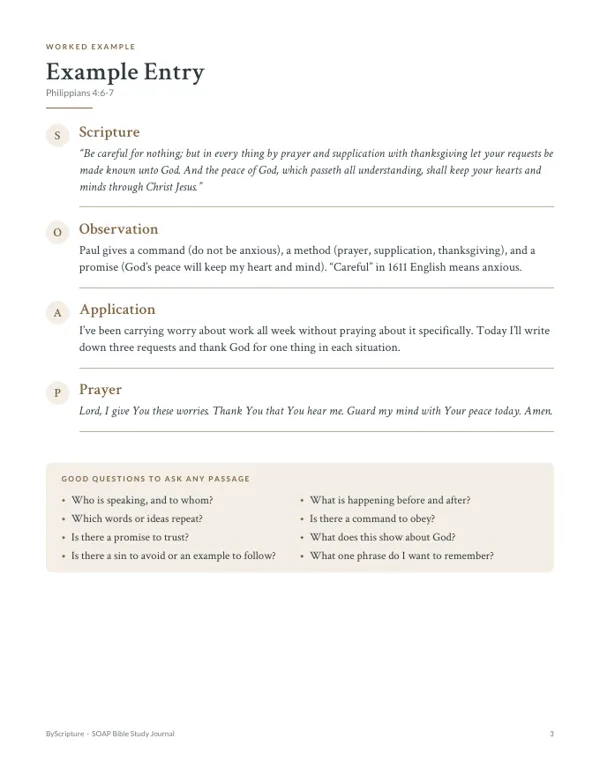
Pick one verse above and write: - Scripture: copy the verse by hand. - Observation: what does it say? Who is speaking, to whom? - Application: what does it mean for you today? - Prayer: turn it into a two-line prayer.
New to this method? See our Bible study guide or pick a Bible reading plan.
Write out 1 Corinthians 15 with the free Scripture writing plan · Study the Resurrection Chapter with the SOAP Bible Study Journal · Download our free SOAP study page
Frequently asked questions
What is 1 Corinthians 15 about?
1 Corinthians 15 is about the resurrection of Jesus and of believers. Paul restates the gospel (15:1-4), lists eyewitnesses of the risen Christ (15:5-11), shows that without the resurrection faith is empty (15:12-19), explains Christ as the firstfruits of a coming resurrection (15:20-28), describes the new resurrection body (15:35-49) and ends with victory over death (15:50-58).
What does 1 Corinthians 15:3-4 say?
In the KJV, 1 Corinthians 15:3-4 says that "Christ died for our sins according to the scriptures; And that he was buried, and that he rose again the third day according to the scriptures" (1 Corinthians 15:3-4). It is one of the earliest summaries of the gospel, which Paul says he received and passed on. It includes Christ's death, its purpose, His burial and His resurrection.
Why is 1 Corinthians 15 read at Easter and funerals?
1 Corinthians 15 is read at Easter because it is the fullest teaching in the Bible on what Christ's resurrection means. It is read at funerals because it promises that believers who have died, those who sleep, will be raised with new, incorruptible bodies, and because it ends with "O death, where is thy sting? O grave, where is thy victory?" (1 Corinthians 15:55).
Who were the witnesses of the resurrection in 1 Corinthians 15?
Paul lists Cephas (Peter), the twelve, more than five hundred believers at one time, most of whom were still alive when he wrote, James the brother of Jesus, all the apostles, and finally Paul himself (1 Corinthians 15:5-8). The Gospels add the women at the tomb, including Mary Magdalene, who were the first to see the risen Lord.
Sources: All Scripture quotations are from the King James Version (KJV), public domain in the United States. References were checked against the KJV text from bible-api.com.
Related: Resurrection of Jesus · Easter · Eternal life · Death · Victory · Funerals · Heaven · Holy Week timeline
Explore more: All Bible verses by topic · KJV Bible verses · Verse of the day · Prayers · Bible study · Bible reading plans