Psalm 103 is a psalm of David that calls his own soul to praise God: "Bless the LORD, O my soul: and all that is within me, bless his holy name." It lists God's benefits, forgiveness, healing, redemption and mercy, and says He has removed our sins "As far as the east is from the west". It describes God as a father who pities his children and remembers we are dust, and it ends by calling angels, heaven and all creation to bless the LORD.
Psalm 103 is one of the great thanksgiving psalms of the Bible. It has no request in it at all, only praise. David begins by talking to himself, telling his own soul to bless the LORD and not to forget what God has done. Then the psalm widens, from one person's forgiveness to God's dealings with Israel, to the shortness of human life and finally to the angels and the whole universe. Many people know single lines from it: forget not all his benefits, as far as the east is from the west, like as a father pitieth his children. It is read at Thanksgiving, at funerals and at the end of hard years. Below is the full text of Psalm 103 in the King James Version, all 22 verses in twelve short readings, with the meaning of each. For more verses of praise, see Bible verses about gratitude, Bible verses about worship and Bible verses about thanksgiving.
Psalm 103:1-5 (KJV): forget not all his benefits
1. Psalms 103:1-2
"Bless the LORD, O my soul: and all that is within me, bless his holy name. Bless the LORD, O my soul, and forget not all his benefits:"
David preaches to himself: Bless the LORD, O my soul: and all that is within me, bless his holy name. To bless God is to praise Him with gratitude and love. All that is within me means with my whole self, not half-heartedly. Then the reminder: forget not all his benefits. Forgetting is the great enemy of gratitude. We remember our troubles easily and God's gifts slowly, so David tells his soul to count them.
2. Psalms 103:3-4
"Who forgiveth all thine iniquities; who healeth all thy diseases; Who redeemeth thy life from destruction; who crowneth thee with lovingkindness and tender mercies;"
Here the benefits begin: Who forgiveth all thine iniquities; who healeth all thy diseases. Forgiveness comes first, because it is our deepest need. God heals, sometimes in this life and finally in the resurrection. He redeemeth thy life from destruction, buying it back from the pit, and crowneth thee with lovingkindness and tender mercies. A forgiven sinner wears a crown of God's steadfast love. See Bible verses about healing.
3. Psalms 103:5
"Who satisfieth thy mouth with good things; so that thy youth is renewed like the eagle's."
Who satisfieth thy mouth with good things; so that thy youth is renewed like the eagle's. God fills our lives with good, and the result is renewal. The eagle was a symbol of strength and long life, and ancient readers believed eagles renewed their feathers each year. Isaiah used the same picture: they shall mount up with wings as eagles (Isaiah 40:31). Even in old age, God can give a fresh, youthful strength of spirit.
Psalm 103:6-14 (KJV): merciful and gracious
4. Psalms 103:6-7
"The LORD executeth righteousness and judgment for all that are oppressed. He made known his ways unto Moses, his acts unto the children of Israel."
Now David widens the view: The LORD executeth righteousness and judgment for all that are oppressed. God is on the side of the oppressed. Then he remembers Israel's history: He made known his ways unto Moses, his acts unto the children of Israel. The people saw God's acts, the plagues, the Red Sea and the manna, but Moses was shown His ways, the character behind the acts. The next verse quotes what God told Moses.
5. Psalms 103:8-9
"The LORD is merciful and gracious, slow to anger, and plenteous in mercy. He will not always chide: neither will he keep his anger for ever."
The LORD is merciful and gracious, slow to anger, and plenteous in mercy. This is God's own description of Himself on Mount Sinai (Exodus 34:6), the verse most quoted inside the Old Testament. He will not always chide: neither will he keep his anger for ever. God does discipline His children, but His anger is not His last word. His mercy is. If you are carrying guilt you have already confessed, these verses are for you.
6. Psalms 103:10-11
"He hath not dealt with us after our sins; nor rewarded us according to our iniquities. For as the heaven is high above the earth, so great is his mercy toward them that fear him."
He hath not dealt with us after our sins; nor rewarded us according to our iniquities. This is grace: not getting what we deserve. Then David tries to measure God's mercy and runs out of measuring tools: For as the heaven is high above the earth, so great is his mercy toward them that fear him. Look up at the sky on a clear night. However far it goes, God's mercy toward those who reverence Him goes farther.
7. Psalms 103:12
"As far as the east is from the west, so far hath he removed our transgressions from us."
As far as the east is from the west, so far hath he removed our transgressions from us. North and south meet at the poles, but east and west never meet. You can travel east forever. That is the distance God puts between a forgiven person and their sin. He does not keep a file of confessed sins to bring up later. Micah says He casts them into the depths of the sea (Micah 7:19). See Bible verses about forgiveness.
8. Psalms 103:13-14
"Like as a father pitieth his children, so the LORD pitieth them that fear him. For he knoweth our frame; he remembereth that we are dust."
Like as a father pitieth his children, so the LORD pitieth them that fear him. Pity here means tender compassion, the way a good father feels when his child is hurt or frightened. And God knows our limits: For he knoweth our frame; he remembereth that we are dust. He made Adam from the dust (Genesis 2:7). God does not expect us to be stronger than we are. He remembers our weakness with compassion, not contempt. See Bible verses about fathers.
Psalm 103:15-22 (KJV): from everlasting to everlasting
9. Psalms 103:15-16
"As for man, his days are as grass: as a flower of the field, so he flourisheth. For the wind passeth over it, and it is gone; and the place thereof shall know it no more."
As for man, his days are as grass: as a flower of the field, so he flourisheth. Human life is beautiful but brief. For the wind passeth over it, and it is gone; and the place thereof shall know it no more. In a hot land, one dry wind could wither a field of wildflowers in a day. These verses are often read at funerals. They are honest about death, but they are not the end of the psalm. The next verse begins with But.
10. Psalms 103:17-18
"But the mercy of the LORD is from everlasting to everlasting upon them that fear him, and his righteousness unto children's children; To such as keep his covenant, and to those that remember his commandments to do them."
But the mercy of the LORD is from everlasting to everlasting upon them that fear him. Our days are like grass, but God's mercy has no beginning and no end. And his righteousness unto children's children: His faithfulness reaches our grandchildren. The promise is To such as keep his covenant, and to those that remember his commandments to do them. A short life held in an everlasting mercy is not a small life. See Bible verses about grandchildren.
11. Psalms 103:19-20
"The LORD hath prepared his throne in the heavens; and his kingdom ruleth over all. Bless the LORD, ye his angels, that excel in strength, that do his commandments, hearkening unto the voice of his word."
The LORD hath prepared his throne in the heavens; and his kingdom ruleth over all. Nothing is outside His reign. Then David begins calling others to praise: Bless the LORD, ye his angels, that excel in strength, that do his commandments, hearkening unto the voice of his word. The mighty angels praise God by listening to Him and obeying Him. That is what praise looks like for us too.
12. Psalms 103:21-22
"Bless ye the LORD, all ye his hosts; ye ministers of his, that do his pleasure. Bless the LORD, all his works in all places of his dominion: bless the LORD, O my soul."
Bless ye the LORD, all ye his hosts; ye ministers of his, that do his pleasure. Then the circle widens to everything: Bless the LORD, all his works in all places of his dominion. And at the very end, after calling the whole universe to praise, David comes back to where he started: bless the LORD, O my soul. The psalm begins and ends with the same line. Praise starts in one heart and returns there, joined now by all creation.
A short prayer
Bless the LORD, O my soul. Father, I do not want to forget Your benefits. Thank You for forgiving all my sins, for healing, for redeeming my life and crowning it with lovingkindness. Thank You that You remember I am dust and that You pity me as a father pities his child. My days are like grass, but Your mercy is from everlasting to everlasting. With everything within me, I bless Your holy name. Amen.
Go deeper: a SOAP study prompt
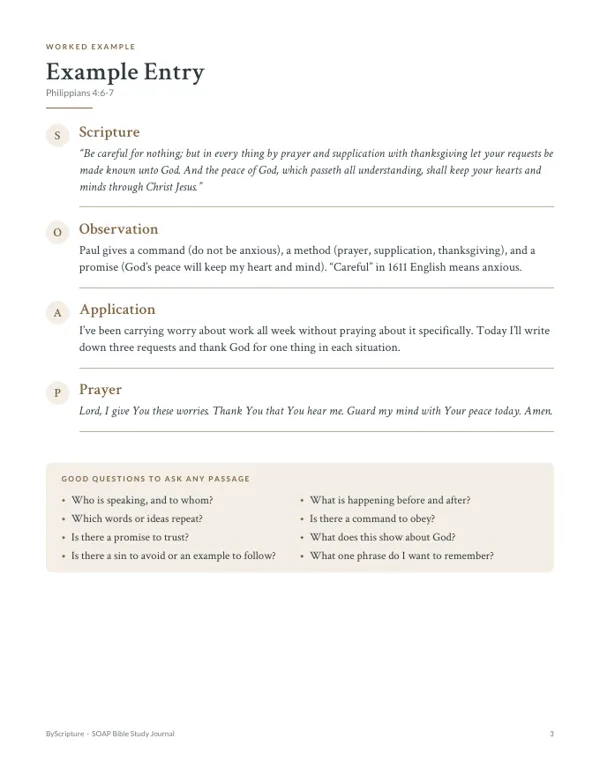
Pick one verse above and write: - Scripture: copy the verse by hand. - Observation: what does it say? Who is speaking, to whom? - Application: what does it mean for you today? - Prayer: turn it into a two-line prayer.
New to this method? See our Bible study guide or pick a Bible reading plan.
Print it in large type: the free Large-Print Psalms, Volume 2 (KJV) · Download the free Thanksgiving printable · Count His benefits in the 30-Day Prayer Journal · Download our free SOAP study page
Frequently asked questions
What is the main message of Psalm 103?
Psalm 103 calls us to praise God and not forget His benefits. Its main message is God's mercy: He forgives, heals, redeems and crowns us with lovingkindness; He is "merciful and gracious, slow to anger, and plenteous in mercy" (Psalm 103:8); and He removes our sins as far as the east is from the west. Because our lives are short, the psalm points us to His everlasting mercy.
Who wrote Psalm 103?
The heading of Psalm 103 in the KJV is A Psalm of David. The psalm itself does not say when David wrote it. Its tone suggests a mature believer looking back on a lifetime of God's forgiveness and care. Psalm 104, which follows, begins with the same line, "Bless the LORD, O my soul," and the two psalms are often read as a pair.
What are the benefits in Psalm 103?
Psalm 103:3-5 lists them: God forgives all your iniquities, heals all your diseases, redeems your life from destruction, crowns you with lovingkindness and tender mercies, and satisfies your mouth with good things, so that your youth is renewed like the eagle's. Verses 6 to 18 add His justice for the oppressed, His mercy, His fatherly compassion and His everlasting faithfulness.
Is Psalm 103 good for Thanksgiving?
Yes. Psalm 103 is one of the best Thanksgiving psalms because it is all praise and no request. Many families read verses 1 to 5 before the Thanksgiving meal and then share one benefit each person does not want to forget. You can pair it with Psalm 100. For more, see our Thanksgiving prayer and Bible verses about Thanksgiving.
Sources: All Scripture quotations are from the King James Version (KJV), public domain in the United States. References were checked against the KJV text from bible-api.com.
Related: Gratitude · Thanksgiving · Worship · Forgiveness · Mercy · Healing · Thanksgiving prayer · Psalm 51 KJV
Explore more: All Bible verses by topic · KJV Bible verses · Verse of the day · Prayers · Bible study · Bible reading plans